
Quick answer: This classic Thanksgiving stuffing combines savory Italian sausage, aromatic fresh sage, and buttery toasted bread cubes for the ultimate holiday side dish. Baked until golden and crisp on top with a moist, custard‑like interior, it’s packed with layers of flavor from caramelized onions, celery, and garlic. Ready in about 2 hours, it serves 10–14 people and can be made a day ahead.
- What Is This Thanksgiving Stuffing?
- Why You’ll Love This Recipe
- Ingredients
- Equipment
- Step‑by‑Step Instructions
- Step 1: Dry Out the Bread
- Step 2: Increase Oven Temperature and Prep the Dish
- Step 3: Cook the Sausage
- Step 4: Sauté the Vegetables
- Step 5: Combine Everything
- Step 6: Transfer to Baking Dish
- Step 7: Bake the Stuffing
- Step 8: Rest and Serve
- Expert Chef Tips
- Troubleshooting
- Recipe Variations
- Serving Suggestions
- Storage & Reheating
- Frequently Asked Questions
- Nutrition
- Recipe Card
| Prep Time | 25 minutes |
|---|---|
| Cook Time | 1 hour 15 minutes |
| Total Time | ~2 hours (plus bread drying) |
| Servings | 10 – 14 |
| Calories | ~320 per serving |
| Difficulty | Easy to Medium |
| Best Occasion | Thanksgiving, Christmas, holiday feasts, Sunday suppers |
There’s nothing quite like the smell of classic sage and sausage stuffing baking in the oven on Thanksgiving morning. Honestly, I think it might be my second favorite part of the holiday – right after the pumpkin pie, obviously.[reference:0]
I’ve been making this recipe for about eight years now, ever since I attempted my first Thanksgiving dinner and realized that boxed stuffing just wasn’t going to cut it anymore.[reference:1] That first year, I learned the hard way that skipping the bread‑drying step leads to soggy stuffing. But with a little trial and error – and a few phone calls to my grandmother – I landed on a version that’s been on our table every year since.[reference:2]
This homemade stuffing is everything you want in a Thanksgiving side dish – crispy golden edges, a moist and flavorful center, and that perfect balance of savory sausage with aromatic sage.[reference:3] The combination of Italian sausage, fresh sage, and buttery toasted bread creates layers of savory goodness in every bite.[reference:4] And the best part? It’s actually way easier than most people think.[reference:5]
Whether you call it stuffing or dressing, it’s a side dish that’s always a scene‑stealer at the holiday table.[reference:6] This recipe is the platonic ideal of this Thanksgiving classic – boasting the custard‑like texture of a savory bread pudding.[reference:7] It’s the dish that deserves prime real estate on your holiday table, and I’m so excited to share it with you. Let’s get cooking.
What Is This Thanksgiving Stuffing?
At its heart, this is a classic bread stuffing – a savory mixture of dried bread cubes, browned sausage, sautéed vegetables, and fresh herbs, bound together with eggs and broth, then baked until golden and crisp on top with a moist, custardy interior.[reference:8] It’s the quintessential Thanksgiving side dish, often served alongside roasted turkey, mashed potatoes, and cranberry sauce.
The combination of pork sausage, sage, and buttery toasted bread creates an aromatic, flavor‑packed dish whether you bake it in a dish or use it to stuff poultry.[reference:9] While it’s technically “dressing” when it bakes outside the turkey, that’s exactly how you get the best texture – and keep your turkey from overcooking.[reference:10]
A Tradition of Comfort
Stuffing has deep roots in American culinary history, evolving from European forcemeat dishes that were used to stuff poultry and game. Early American cooks would fill their birds with a mixture of breadcrumbs, herbs, and whatever meats or vegetables were on hand. Over time, regional variations emerged – some with cornbread, others with oysters, and many with sausage and sage.
Today, sausage and sage stuffing is the gold standard for many families. The sausage adds richness, seasoning, and just the right amount of savoriness without needing many extra ingredients.[reference:11] Sage brings that unmistakable Thanksgiving flavor, while parsley adds freshness and cuts through the richness of the sausage and butter.[reference:12] It’s a dish that feels both nostalgic and endlessly satisfying.
Flavor & Texture Profile
- Flavor: Savory, herbaceous, and deeply satisfying – with rich pork sausage, earthy sage, sweet caramelized onions, and a hint of butteriness
- Texture: Golden and crispy on top, moist and custard‑like in the center – with tender bread cubes that have absorbed all the savory juices
- Why people love it: It’s the ultimate comfort food – nostalgic, festive, and packed with the flavors that define Thanksgiving. It pairs perfectly with roast turkey and gravy
Why You’ll Love This Recipe
- Absolutely packed with flavor – The combination of Italian sausage, fresh sage, and buttery toasted bread creates layers of savory goodness in every bite[reference:13]
- Perfect texture every time – Crispy, golden top with a moist (not mushy!) interior that holds together beautifully[reference:14]
- Make‑ahead friendly – Assemble everything the day before and just pop it in the oven on Thanksgiving Day[reference:15]
- Feeds a crowd – This recipe serves 10–14 people, so it’s perfect for large family gatherings[reference:16]
- Classic comfort food – This is the traditional Thanksgiving stuffing recipe that everyone expects and loves[reference:17]
- Versatile base recipe – Easy to customize with your favorite add‑ins like mushrooms, apples, or dried cranberries[reference:18]
- Better than boxed – Once you’ve made homemade stuffing, you’ll never go back to the boxed stuff
- Freezer‑friendly – Freeze leftovers for a quick side dish later in the holiday season
Ingredients
| Ingredient | Amount | Notes |
|---|---|---|
| High‑quality sandwich bread or soft Italian bread | 2½ pounds (about 2 loaves) | Cut into ¾‑inch cubes; avoid pre‑seasoned or overly crusty bread[reference:19] |
| Unsalted butter | 8 tablespoons (1 stick) | Divided, plus more for greasing the dish |
| Italian sausage (mild or hot) | 1½ pounds | Casings removed; any good‑quality pork sausage works[reference:20] |
| Large onion | 1 large (about 12 oz) | Finely chopped[reference:21] |
| Celery ribs | 4 large (about 12 oz) | Finely chopped[reference:22] |
| Garlic cloves | 2 – 3 | Minced or grated[reference:23] |
| Fresh sage leaves | ¼ cup | Finely chopped (or 2 teaspoons dried sage)[reference:24] |
| Fresh parsley | ¼ cup | Minced, divided[reference:25] |
| Fresh thyme leaves | 2 teaspoons | Optional, but adds lovely depth[reference:26] |
| Kosher salt | To taste | Adjust based on your sausage’s saltiness[reference:27] |
| Freshly ground black pepper | To taste | |
| Low‑sodium chicken or turkey stock | 4 cups (1 quart) | Divided[reference:28] |
| Large eggs | 3 | Beaten[reference:29] |
Ingredient Notes
The Bread: You can use almost any type of bread for this stuffing, but I’ve had the best results with a simple white Italian loaf or a sourdough that doesn’t have a thick, tough crust.[reference:30] What matters most is how you prepare it – the texture of your bread can make or break the stuffing.[reference:31] You want cubes that are about ¾ to 1 inch in size, and they need to be very dry and crunchy so they hold their shape and don’t turn mushy once mixed with the broth and eggs.[reference:32] Some recipes call for stale bread, but I prefer using fresh bread that’s been dried out in the oven for better flavor and texture.[reference:33]
The Sausage: I highly recommend using Italian sausage here. It adds richness, seasoning, and just the right amount of savoriness without needing many extra ingredients.[reference:34] Mild or hot both work (as does a chicken Italian sausage), so use whichever your family prefers. Make sure to break it up well as it browns so you get evenly distributed bits in every scoop of stuffing.[reference:35]
The Fresh Herbs: Fresh sage and parsley are essential for keeping this stuffing balanced and aromatic.[reference:36] Sage brings that unmistakable Thanksgiving flavor, while parsley adds freshness and cuts through the richness of the sausage and butter.[reference:37] A little fresh thyme is also lovely, if you have it.[reference:38]
The Liquid: The combination of broth and eggs is what gives this stuffing its perfect texture – custardy underneath with a beautifully crisp top.[reference:39] Use enough broth to moisten the bread without drowning it, and don’t skip the eggs – they help bind everything together.[reference:40]
Ingredient Substitutions
| Dietary Need | Substitution |
|---|---|
| Gluten‑Free | Use a gluten‑free bread (ensure it’s well‑dried); substitute with gluten‑free cornbread for a Southern‑style version[reference:41] |
| Dairy‑Free | Use dairy‑free butter or olive oil; ensure your sausage is dairy‑free |
| Vegetarian | Substitute the sausage with a plant‑based sausage alternative or double the mushrooms for umami |
| Lower Sodium | Use low‑sodium sausage and low‑sodium broth; adjust salt to taste |
| No Pork | Use chicken or turkey sausage; or use a plant‑based sausage |
| Add Sweetness | Add 1 cup of peeled and diced apple or ½ cup of dried cranberries for a sweet‑savory twist[reference:42][reference:43] |
Equipment
Essential Tools:
- Large rimmed baking sheet (for drying the bread)
- Large skillet (for browning sausage and cooking vegetables)
- Large mixing bowl (for combining all the ingredients)[reference:44]
- Baking dish (3‑quart or 9×13‑inch)[reference:45]
- Wooden spoon or silicone spatula[reference:46]
- Sharp knife and cutting board[reference:47]
- Measuring cups and spoons[reference:48]
- Whisk (for beating eggs and stock)[reference:49]
- Aluminum foil (for covering while baking)
Nice‑to‑Have: A kitchen scale (for accurate bread measurement), a fat separator (for skimming fat if needed), a slow cooker (for keeping stuffing warm).
Step‑by‑Step Instructions
Step 1: Dry Out the Bread
Preheat your oven to 275°F (135°C). Spread the cubed bread across two large baking sheets in a single layer. Bake for 45–50 minutes, stirring occasionally, until the bread is completely dried out and slightly golden.[reference:50] Let the bread cool completely on the baking sheets.
Why This Matters: This step is REALLY important! I learned this the hard way my first year when I skipped it and ended up with soggy stuffing.[reference:51] The dried bread absorbs all those delicious flavors without turning into mush.[reference:52]
Visual Cue: The bread should be crunchy and pale golden, with no soft spots remaining.
Step 2: Increase Oven Temperature and Prep the Dish
Increase the oven temperature to 375°F (190°C). Grease a 3‑quart baking dish or 9×13‑inch pan with butter.[reference:53]
Step 3: Cook the Sausage
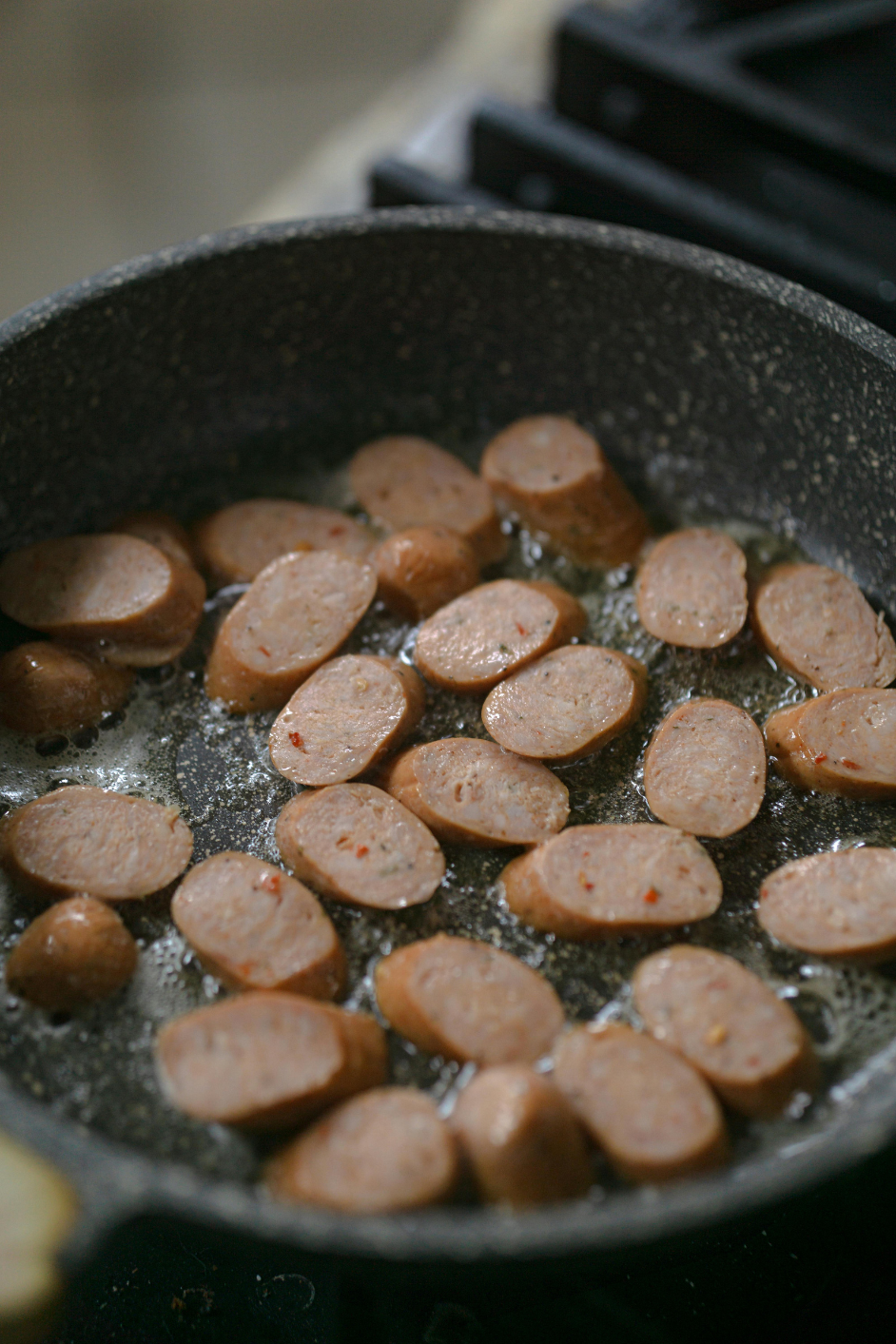
In a large skillet over medium‑high heat, melt 2 tablespoons of butter. Add the sausage (casings removed) and cook, breaking it up into small pieces with a wooden spoon, until browned and cooked through, about 6–8 minutes.[reference:54] Use a slotted spoon to transfer the sausage to a large mixing bowl, leaving the fat behind in the skillet.[reference:55]
Aroma Cue: The rich, savory scent of browning sausage will fill your kitchen – this is the foundation of your stuffing’s flavor.
Step 4: Sauté the Vegetables
Return the skillet to medium heat. Add the remaining 6 tablespoons of butter. Once melted, add the chopped onion, celery, and garlic. Season generously with salt and pepper.[reference:56] Cook, stirring occasionally, until the vegetables are softened and starting to brown at the edges, about 10–12 minutes.[reference:57][reference:58]
Stir in the fresh sage, thyme (if using), and half of the parsley. Cook just until fragrant, about 30 seconds.[reference:59]
Visual Cue: The onions should be translucent and the celery tender – they should have developed a light golden color.
Step 5: Combine Everything
Scrape the vegetable mixture into the large bowl with the sausage and dried bread cubes.[reference:60] Add the remaining parsley and toss gently to combine.[reference:61]
In a separate bowl, whisk together the eggs and 2 cups of the stock until no streaks remain.[reference:62] Pour the egg mixture over the bread mixture and gently toss until everything is evenly moistened.[reference:63] Gradually add the remaining stock, a little at a time, tossing between additions, just until the bread cubes are moistened but no liquid pools at the bottom of the bowl.[reference:64] (You may not need all of the stock.)
Visual Cue: The bread should be evenly damp but not sodden – it should hold together when squeezed gently.
Step 6: Transfer to Baking Dish
Transfer the stuffing mixture to the prepared baking dish, spreading it in an even layer. Press down lightly to compact it slightly.[reference:65]
Chef Tip: Don’t pack it too tightly – you want some air pockets for that perfect crispy‑to‑moist ratio.[reference:66]
Step 7: Bake the Stuffing
Cover the dish tightly with foil.[reference:67] Bake for 30 minutes. Remove the foil and continue baking for another 15–20 minutes, until the top is golden brown and crisp.[reference:68][reference:69]
Visual Cue: The top should be deeply golden and slightly crackly, with some crispy edges. The center should be set and moist but not wet.
Aroma Cue: The warm, herbaceous scent of sage, butter, and sausage will fill your kitchen – this is the smell of Thanksgiving.
Step 8: Rest and Serve
Let the stuffing rest for about 10 minutes before serving. Sprinkle with a little more fresh parsley on top.[reference:70] Serve warm alongside your Thanksgiving turkey and all the trimmings.
Expert Chef Tips
- Dry the bread thoroughly: This is the most important step. Dried bread absorbs the flavorful liquid without turning mushy. Don’t rush it – the bread should be completely crunchy.[reference:71]
- Use good‑quality sausage: Italian sausage is ideal because it’s already well‑seasoned. Look for sausage with a good fat content – it adds richness to the stuffing.[reference:72]
- Cook vegetables low and slow: Let the onions and celery soften and caramelize slightly – this builds a deep, sweet flavor base.[reference:73]
- Add liquid gradually: You may not need all the stock. Add it a little at a time and toss – you want moistened bread, not soggy bread.[reference:74]
- Don’t overpack the dish: Leave some air space in the baking dish so the top can get crispy and the center can stay custardy.[reference:75]
- Make ahead: Assemble the stuffing (through Step 6) up to 2 days ahead, cover, and refrigerate. Add an extra 10–15 minutes to the baking time if baking straight from the fridge.[reference:76][reference:77]
- Toast the bread with herbs: For an extra layer of flavor, toss the bread cubes with a little melted butter and dried herbs before drying them in the oven.
- Use fresh herbs: Fresh sage and parsley are essential – dried herbs just won’t deliver the same bright, aromatic flavor.[reference:78]
Troubleshooting
| Problem | Cause | Solution |
|---|---|---|
| Soggy stuffing | Bread wasn’t dried enough or too much liquid was added | Next time, dry the bread thoroughly and add liquid gradually; for now, bake uncovered for an extra 10–15 minutes to crisp up |
| Dry stuffing | Not enough liquid or overbaked | Add a splash of warm stock before serving; next time, use all the stock and cover for the first part of baking |
| Top isn’t crispy | Dish was covered too long or not enough butter | Uncover for the last 20 minutes of baking; brush with a little melted butter before the final bake |
| Stuffing falls apart | Not enough eggs or too much liquid | Eggs help bind the stuffing – don’t skip them; next time, use all 3 eggs and ensure proper liquid ratio |
| Not flavorful enough | Not enough salt, herbs, or the sausage was too mild | Season generously; use high‑quality sausage; add an extra tablespoon of fresh sage |
| Burnt top | Oven too hot or baked uncovered too long | Cover with foil for the first 30 minutes; reduce oven temperature to 350°F if needed |
Recipe Variations
- Apple and Sausage Stuffing: Add 2 peeled, diced apples to the vegetable mixture – they add a sweet, bright contrast to the savory sausage.[reference:79]
- Cranberry‑Sage Stuffing: Fold in 1½ cups of fresh or frozen cranberries along with the bread for a tart, festive twist.[reference:80]
- Cornbread Sausage Stuffing: Replace half the bread with crumbled cornbread for a Southern‑style version.[reference:81]
- Mushroom and Sausage Stuffing: Sauté 8 oz of sliced cremini mushrooms with the vegetables for extra umami.[reference:82]
- Slow Cooker Version: After combining all ingredients, transfer to a greased slow cooker. Cook on LOW for 4–5 hours or HIGH for 2–3 hours.[reference:83]
- Make‑Ahead Freezer Version: Assemble the stuffing (through Step 6), wrap tightly, and freeze for up to 3 months. Bake from frozen at 375°F for 1 hour covered, then 20–30 minutes uncovered.
- Leek and Sausage Stuffing: Substitute the onion with leeks for a milder, sweeter flavor.[reference:84]
Serving Suggestions
Classic pairings: Serve this stuffing alongside a golden roasted turkey, creamy mashed potatoes, rich gravy, cranberry sauce, and green bean casserole. It’s the ultimate Thanksgiving plate.
Leftover ideas: Use leftover stuffing to make stuffing waffles (press into a waffle iron until crisp), or stuff it into chicken breasts or pork chops for a next‑day dinner. It also makes a delicious addition to a breakfast hash.
Presentation: Serve the stuffing in a beautiful ceramic baking dish right at the table – the golden, crispy top is a feast for the eyes. Garnish with fresh sage leaves and a sprinkle of parsley for a polished look.
Storage & Reheating
Refrigeration: Store leftover stuffing in an airtight container in the refrigerator for up to 4 days.
Freezing: Freeze fully cooled stuffing in a freezer‑safe container for up to 3 months. Thaw in the refrigerator overnight before reheating.
Reheating (Oven – best): Reheat at 350°F for 15–20 minutes, covered with foil, until warmed through. Remove the foil for the last 5 minutes to re‑crisp the top.
Reheating (Microwave): Reheat individual portions in the microwave for 1–2 minutes. The texture won’t be as crispy, but it’s quick and convenient.
Make‑Ahead Tip: Assemble the stuffing (through Step 6) up to 2 days ahead and refrigerate. When ready to bake, add an extra 10–15 minutes to the covered baking time.[reference:85]
Frequently Asked Questions
What is the best bread for stuffing?
A simple white Italian loaf or sourdough without a thick, tough crust works best. The bread should be cut into ¾‑inch cubes and dried thoroughly in the oven until crunchy.[reference:86]
Do I have to dry the bread?
Yes – this is essential. Dried bread absorbs the flavorful liquid without turning mushy. Fresh bread will result in a soggy, dense stuffing. Dry it in the oven at 275°F for 45–50 minutes.[reference:87]
Can I make this stuffing ahead of time?
Absolutely! Assemble the stuffing (through Step 6) up to 2 days ahead, cover, and refrigerate. When ready to bake, add an extra 10–15 minutes to the covered baking time.[reference:88]
What type of sausage is best?
Italian sausage is highly recommended – it adds richness, seasoning, and just the right amount of savoriness. Mild or hot both work, as does chicken Italian sausage.[reference:89]
Can I use dried herbs instead of fresh?
You can, but fresh sage and parsley are strongly recommended – they provide a bright, aromatic flavor that dried herbs can’t match. If using dried sage, reduce the amount to 2 teaspoons.[reference:90]
How do I get a crispy top?
Bake the stuffing covered for the first 30 minutes, then uncover and bake for an additional 15–20 minutes to allow the top to crisp and brown.[reference:91]
Why is my stuffing dry?
You may not have added enough liquid or it may have been overbaked. Next time, add stock gradually until the bread is evenly moistened, and cover for the first part of baking. Add a splash of warm stock before serving if it’s already dry.
Why is my stuffing soggy?
The bread wasn’t dried enough or too much liquid was added. Make sure the bread is completely crunchy before mixing, and add the stock gradually – you may not need all of it.[reference:92]
Can I freeze leftover stuffing?
Yes – freeze fully cooled stuffing in a freezer‑safe container for up to 3 months. Thaw in the refrigerator overnight and reheat in the oven at 350°F until warmed through.
Is this stuffing gluten‑free?
Not as written – but you can make it gluten‑free by using a gluten‑free bread (ensure it’s well‑dried) or by using gluten‑free cornbread.[reference:93]
Nutrition
Nutrition values are estimates and may vary based on specific ingredients and portion sizes.
| Nutrient | Per Serving (1 of 12) |
|---|---|
| Calories | ~320 |
| Protein | 12g |
| Carbohydrates | 28g |
| Fat | 18g |
| Saturated Fat | 8g |
| Fiber | 2g |
| Sugar | 4g |
| Sodium | ~620mg |
Recipe Card
Recipe Name: Thanksgiving Stuffing – Savory Side with Sausage and Sage
Cuisine: American / Holiday
Course: Side Dish
Prep Time: 25 minutes
Cook Time: 1 hour 15 minutes
Total Time: ~2 hours (plus bread drying)
Servings: 10 – 14
Calories: ~320 per serving
Author: [YKITCHENFLORA]
Ingredients
- 2½ pounds high‑quality sandwich bread or soft Italian bread, cut into ¾‑inch cubes
- 8 tablespoons (1 stick) unsalted butter, divided
- 1½ pounds Italian sausage, casings removed
- 1 large onion, finely chopped
- 4 large celery ribs, finely chopped
- 2 – 3 cloves garlic, minced
- ¼ cup fresh sage leaves, finely chopped
- ¼ cup fresh parsley, minced, divided
- 2 teaspoons fresh thyme leaves (optional)
- Kosher salt and freshly ground black pepper, to taste
- 4 cups low‑sodium chicken or turkey stock, divided
- 3 large eggs, beaten
Instructions
- Dry the bread: Preheat oven to 275°F. Spread bread cubes on baking sheets and bake for 45–50 minutes until completely dry and slightly golden. Cool completely.
- Prep the dish: Increase oven to 375°F. Grease a 3‑quart baking dish with butter.
- Cook sausage: Melt 2 tablespoons butter in a large skillet over medium‑high. Cook sausage, breaking it up, until browned, 6–8 minutes. Transfer to a large bowl with a slotted spoon.
- Sauté vegetables: Melt remaining 6 tablespoons butter in the skillet. Add onion, celery, and garlic. Season with salt and pepper. Cook until softened and browned, 10–12 minutes. Stir in sage, thyme (if using), and half the parsley; cook 30 seconds.
- Combine: Add vegetable mixture to the bowl with sausage and bread. Toss to combine. Whisk eggs with 2 cups stock. Pour over bread mixture and toss. Gradually add remaining stock until bread is moistened but not pooled.
- Bake: Transfer to prepared dish. Cover with foil and bake 30 minutes. Remove foil and bake 15–20 minutes more until golden and crisp on top.
- Serve: Rest 10 minutes. Sprinkle with remaining parsley. Serve warm.
Notes
- Drying the bread thoroughly is essential – don’t skip this step.
- Add stock gradually – you may not need all 4 cups.
- This stuffing can be assembled up to 2 days ahead and refrigerated before baking.
- For a sweet‑savory twist, add 1 cup of diced apple or ½ cup of dried cranberries.
- Leftovers can be frozen for up to 3 months.
Nutrition (per serving, approximate)
Calories: 320 | Protein: 12g | Carbs: 28g | Fat: 18g | Fiber: 2g | Sugar: 4g | Sodium: 620mg
This stuffing has been a labor of love in my kitchen for years – from that first slightly‑soggy attempt to the perfected version that now graces our holiday table every year. It’s the dish that brings everyone to the table, the one that disappears first, and the one that tastes like home. I hope it becomes a beloved tradition in your family too – because some recipes aren’t just food. They’re the memories we make around the table, year after year. Happy Thanksgiving!